





True Sine Inverters
The concepts of "integrity, excellency, and mutual-benefit" enable Longchi to establish a long-term partnership with distributors from more than 50 countries. The annual sales volume amounts to 530 million.

- Product Introduction
Company Profile
The originator of Longchi technology has rooted in the field of solar energy as early as in 1990s. Longchi factory was founded in 2011, occupies 56667 square meter and is located at the center of the Yangtze River Delta-Huzhou,Zhejiang.
Longchi is the forerunner of off-grid solar energy system and home energy storage solutions in China, aiming to improve the energy supply situation especially in rural areas. With strong R&D, reliable quality, and strict supply chain management, Longchi products have been testified for peak performance and long life. The concepts of "integrity, excellency, and mutual-benefit" enable Longchi to establish a long-term partnership with distributors from more than 50 countries. The annual sales volume amounts to 530 million.
Why Choose Us
High quality
Our products are manufactured or executed to very high standards, using the finest materials and manufacturing processes.
Quality control
We have professional personnel to monitor the production process, inspect the products and ensure that the final product meets the required quality level standards, guidelines and specifications.
Delivery speed
We have huge production capacity to ensure on-time delivery and transportation to the destination as soon as possible.
24h online service
We try and respond to all concerns within 24 hours and our teams are always at your disposal in case of any emergencies.

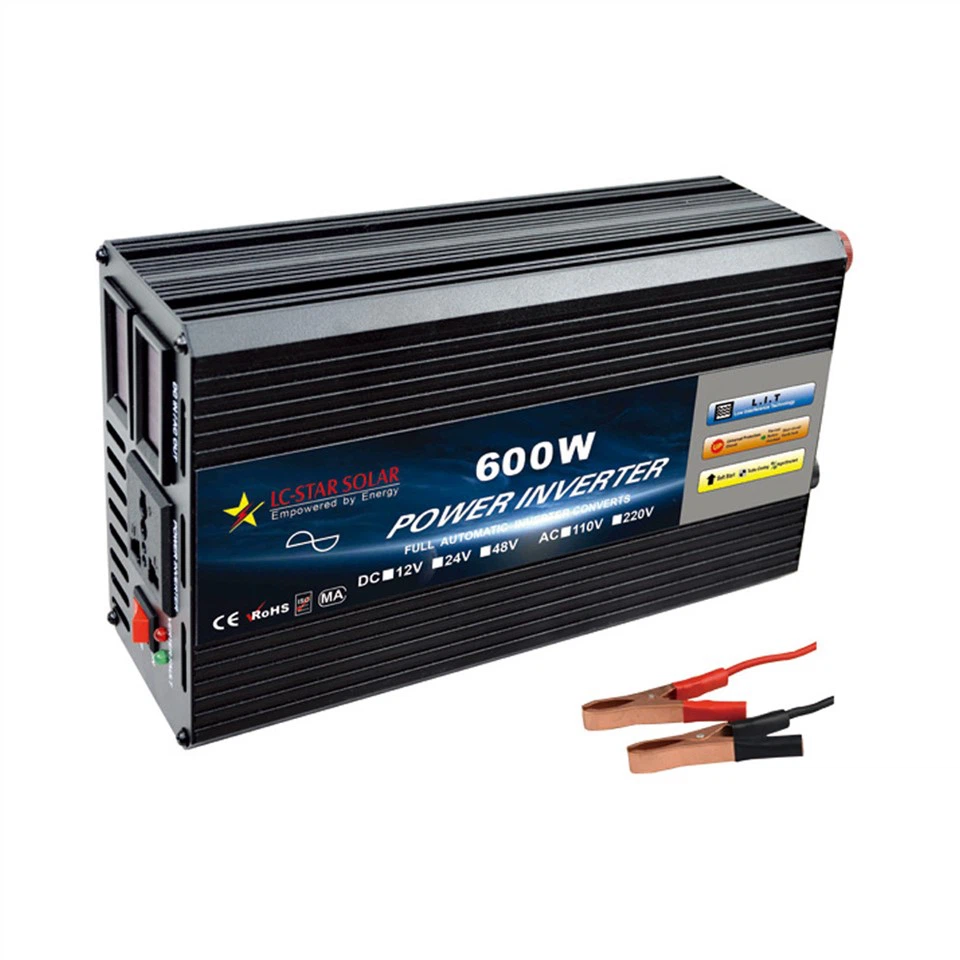


What is True Sine Inverters?
True Sine Wave Inverter provides clean, reliable AC power. With a True Sine Wave output, the inverter is able to power all electrical loads up to 1,800W; including sleep apnea machines, tools, motors and other demanding electrical devices. When shore power is available, a built-in 20A relay automatically transfers to incoming AC utility power, minimizing battery discharge and eliminating the need for an external transfer switch.
Any sine wave is repetitive in nature. After any fixed time period, also called a cycle, it repeats itself. In the sine wave pattern every cycle is identical.Another important aspect is its oscillatory nature. In any cycle, the sine wave will have its periods of crests and troughs. The crests will be exactly symmetrical to the troughs, but in opposite direction.
Advantages of True Sine Inverters
Same current as power grids
True Sine Inverters a wave that is very similar to the smooth wave form generated by mains electricity. That is, there is no discernible difference between plugging your devices into these inverters and plugging them into a wall outlet.
This, of course, means that you can use almost any device during a power outage
Minimal risk to devices
The smooth wave form produced by a pure sine wave inverter also protects your high-end electronics from damage during power outages. After all, you don't want your gaming computer or oxygen machine to fail during a power outage.
Furthermore, using modified sine wave inverters with AC-powered devices such as microwaves and refrigerators can generate excessive waste heat, putting your devices at risk. Pure sine wave inverters, on the other hand, pose no threat to any of your devices.
Consistent, smoother current flow
A pure wave inverter, as opposed to modified wave inverters, provides consistent, uninterrupted power to your devices. What makes this so great? Because modified sine wave inverters produce power in a step pattern, the voltage abruptly rises and falls, resulting in inconsistent current flow to your devices, which can be harmful in the long run. When shopping for a solar inverter for your home, it's best to go with pure sine wave inverters.
Quiet operation
When using standard inverters, you may occasionally hear an annoying humming sound from lights and fans. When using a pure wave inverter, this is not the case. The waves produced by these inverters make very little noise. Pure wave inverters are simply cleaner, cooler, and quieter.
Compatibility with a wide range of devices
Because of the grid-like wave pattern and power these inverters produce, almost all devices work with them, including:
• Refrigerators, microwaves, and compressors
• Audio/video equipment
• Satellite communication systems
• Medical devices such as oxygen concentrators and CPAP machines for sleep apnoea, among others.
• Battery chargers, light dimmers, bread makers, and a variety of other items
3 Types Of Inverters With Different Wave Types
Inverters are not only divided in terms of their power capacity and into standard or customized inverters. They are also divided based on their waves into sine wave inverters or 'true' or 'pure' sine wave, modified sine wave and square wave.
Sine wave inverters
Your local utilities and generators rotating AC machinery produce sine waves, which are natural products of rotating AC machinery. The biggest advantage of investing in these inverters is that most equipment is designed for sine waves.
This ensures tha equipment, such as microwave ovens and motors, works to full specifications. There are also some appliances, such as light dimmers, bread makers and some battery chargers, that need sine wave to function. It is this increased need and applications of sine wave inverters that make it twice or more expensive than others.
Modified sine wave
These inverters have a square wave-like waveform with an additional step or two. They may work well with most equipment, but compromises the equipment's power or efficiency. Some equipment, such as motor pumps, fans, and refrigerator pumps, consume more power from the inverter because of low efficiency.
Motors usually consume 20% more power because most modified sine wave inverters have higher frequencies, which motors cannot use. This is why you may notice that fluorescent lights are not as bright as usual, or hear some buzzing or annoying humming noises.
Even appliances with digital clocks and electronic timers will not work properly because their timing depends on power. As modified sine waves are noisier and rougher than pure sine waves, the clocks either fun faster or don't work at all.
Square wave
These are the cheapest inverters that safely run simple things such as tools with universal motors. But they are not seen around much these days because square wave inverters do not have many applications.

The True Sine Inverters does not have the problem of electromagnetic pollution in the power grid, and the output is the same pure sine wave alternating current as of the mains. It has stronger load capacity, can carry the inductive load and any type of general-purpose AC load, has low noise with inductive load, and has no effect on the performance and life of the load.
In contemporary times, we now need a large amount of power supply, and the convenience brought to us by True Sine Inverterss is obvious. Protection devices make us safer when using electricity. Pure sine wave inverte.
True Sine Inverterss are also used in transportation systems, small passenger cars, cars, RVs, large trucks, motor trains, trains, airplanes and other transportation vehicles. Generally, the above types of transportation equipment are the operation of DC power. With the improvement of our quality of life, users can pick up some AC loads to meet our new needs when choosing equipment. These all require the conversion of direct current to the alternating current through an inverter. The direct supply of these devices has also brought us some convenience.
They are also widely used in railways, industrial control, communication and exchange vehicles, civil offices, industrial and agricultural fields, military medical fields, transportation, etc. True Sine Inverters not only brings convenience to current conversion but also brings us different protection measures, such as over-voltage protection, overload protection, over-current protection, over-temperature protection, short circuit protection, positive and negative protection, etc. The safest and most perfect experience for our users. It also protects the safety of users.
Process of True Sine Inverters
DC Power Input: TheTrue Sine Invertersis connected to a DC power source, such as a battery or a DC power supply.
Pulse Width Modulation (PWM): The DC power is converted into a high-frequency AC signal using Pulse Width Modulation (PWM). In this process, the DC power is rapidly switched on and off at a high frequency, typically tens of thousands of times per second, to create a square wave AC signal.
Filter Stage: The square wave AC signal is then passed through a filter stage, which smoothens the signal and removes the high-frequency components, resulting in a closer approximation of a sine wave.
Voltage Regulation: The filtered AC signal is then fed into a voltage regulation stage, where the output voltage is adjusted to match the desired AC output voltage, typically 120V or 230V, depending on the region and application.
Sine Wave Generation: The adjusted AC signal is then processed through a sine wave generation stage, which uses complex algorithms and techniques to convert the square wave or modified sine wave into a pure sine wave. This process involves shaping the waveform to replicate the smooth curve of a natural sine wave.
Output Stage: Finally, the pure sine wave output is amplified to the required power level and sent to the AC outlets of the inverter, where it can be used to power a wide range of electronic devices and appliances, just like utility company power.
Additional Features: Many pure sine wave inverters also come with additional features, such as surge protection, over-voltage protection, short-circuit protection, and more, to ensure safe and reliable operation of connected devices.
How To Install A Pure Sine Wave Inverter?
Plug & Play
- Here, a pure sine wave inverter connected to a battery supplies power to a particular electrical device.
- Pure Sine Wave Inverter Connected To A Solar System
- The inverter conects to a bank of solar panels. These panels converts solar energy into electrical energy that the inverter uses to produce AC electricity.
- Pure Sine Wave Inverter Connected To Batteries
- The inverter connects to a domestic power supply. The inverter inverts the AC into DC electricity to charge a battery. When the AC domestic power supply fails, the inverter uses DC power from the batteries and converts it in to AC power.
- Plug & Play
Plug and play units consist of an inverter and a battery conveniently housed as a unit. The wiring from the battery connects to the inverter, making installation and operation super easy.
These units use the regular domestic supply of electricity to charge the battery. In the event of a power failure, the inverter draws power from the battery to supply 120V to the appliances connected to the inverter.
Plug and play units make use of a two-way sequence. First, 120V AC is inverted to 12V DC to charge the battery. Then 12V DC is converted to 120V AC to power the connected appliances.
Step 1:The first important step is determining the device's power requirements you want to connect. To do this, you'll need to look at the label on the device to find out the power (Watts) or the amps required to run the electrical equipment.
Step 2:Having made sure that the pure sine wave inverter can produce sufficient power, all that is left to be done is to plug in the inverter at the wall socket and plug in your device in the socket on the inverter.
Step 3:If the battery is charged, you can test the inverter. Do this by switching off the power from the wall socket and checking that your device is still running.
Connecting A Pure Sine Wave Inverter To A Solar Panel System
Now we will deal with installing the pure sine wave inverter onto a solar panel system.
By now, you'll be familiar with solar energy being converted into electrical power via solar panels. The DC electricity from the solar panels passes through a charge controller that ensures an almost constant supply of electricity to the batteries.
- Connecting A Pure Sine Wave Inverter To Batteries
Please take care of the solar panels' electricity before getting into the nuts and bolts of connecting the inverter. Somehow it seems that people tend to disregard the electricity delivered by the solar panels until they get startled by a spark or, even worse, get shocked.
Step 1:If you have solar panels receiving sunlight, it is good to remove the connections from the panels to the charge controller before you go any further.
Step 2:Disconnect the batteries from the charge controller.
Step 3:Now you can connect the pure sign wave inverter to the batteries. It is essential to connect the positive and the negative wires to the inverter first.
Then connect the negative terminal of the inverter to the battery's negative terminal. Once that has been done, connecting the positive cable from the inverter to the battery is safe. Just to be safe, it is always a good idea to fit a fuse at the positive terminal.
Step 4:You will need to reconnect the charge controller to the battery and reconnect the cables from the solar panels to the charge controller.
Step 5:Switch the inverter on to check that it draws power from the batteries. The inverter screen will provide a readout of the voltage available. Plug an appliance into the inverter and switch it on to test the system.
For our purposes here, we're going to assume that you have calculated the power requirements of the inverter by adding up the watts of each piece of equipment you are hoping to use the pure sine wave inverter to power up.
Why Choose A Pure Sine Wave Inverter?
Pure sine wave inverters cost more than a modified sine wave inverter, but the added expense is required if you intend to run sensitive equipment or devices with AC motors.
We don't need to go into the wave patterns of AC but suffice to say that many of the appliances we use rely on a smooth sine wave to function effectively.
Checking The Power Requirements Of Your Appliances
It's essential that you check that both the battery sizes and the pure sine wave inverter will deliver sufficient power for the equipment you intend to use.
Essential Maintenance Tips for Getting the Most Out of Your Inverter
Check battery health when it is fully charged
If you don't know how to check inverter battery health, you can skip this step. But if you are conducting an inverter battery maintenance check, it is vital that you do it when the battery is fully charged. Make sure that the battery was connected for at least 10-15 hours to get charged and before examining the health, remove the inverter from the front panel as well as the wall socket.
Clean the battery terminals regularly
Inverter battery produces lead sulphate during normal operation. Lead sulphate gets deposited on the battery terminals and can reduce the electrical conductivity of your inverter. It deters current flow from the inverter and the machine becomes less efficient over time if it isn't cleaned properly with warm water and a nylon brush.
Check the acid level regularly
In a lead-acid battery, one of the two most important things besides lead is the acid. The float indicators in the inverter depict the acid level inside it, and for the proper functioning of the inverter, it is necessary that the acid level remains equal in all the cells. If the level is less in any float indicator, top it up with distilled water. Make sure that you don't overflow the indicator with excess acid as well. Acid colour also indicates the health of the inverter, and if your acid comes out colourless after opening the vent, the inverter is working fine. But if it comes out brown or black in colour, the battery might be contaminated or nearing the end of its life.
Store the inverter in an airy space
An inverter can generate a lot of heat while operating and this heat can be the cause of its downfall. While installing an inverter at home, make sure that it is placed in an airy space with lots of room for the heat to dissipate, so that it doesn't harm the functioning of the inverter.
Keep the battery surface clean
Accumulation of dirt or dust on the battery surface can also hinder electricity conduction from the inverter to the converter. It can deposit on the terminals and disrupt the power flow, so try to keep the battery surface clean as much as you can.
Use the inverter regularly
The inverter should be used regularly to maintain the charge. It is recommended to discharge the inverter battery once a month at least. Even if there is no power cut for a whole month, try to use the appliances on the inverter battery and discharge it completely.
Maintain wire health
While the battery is the most important part of the inverter, you shouldn't ignore the wiring as well. Crimp, broken, or damaged wire can not only decrease the efficiency of the inverter, but also lead to accidents like short-circuits and fires. Inspect and maintain wire health regularly.
Certifications


FAQ
Hot Tags: true sine inverters, China true sine inverters manufacturers, suppliers, factory, residential energy storage development, , inverter protection features, inverter for camping, inverter parallel operation, domestic energy storage demand


